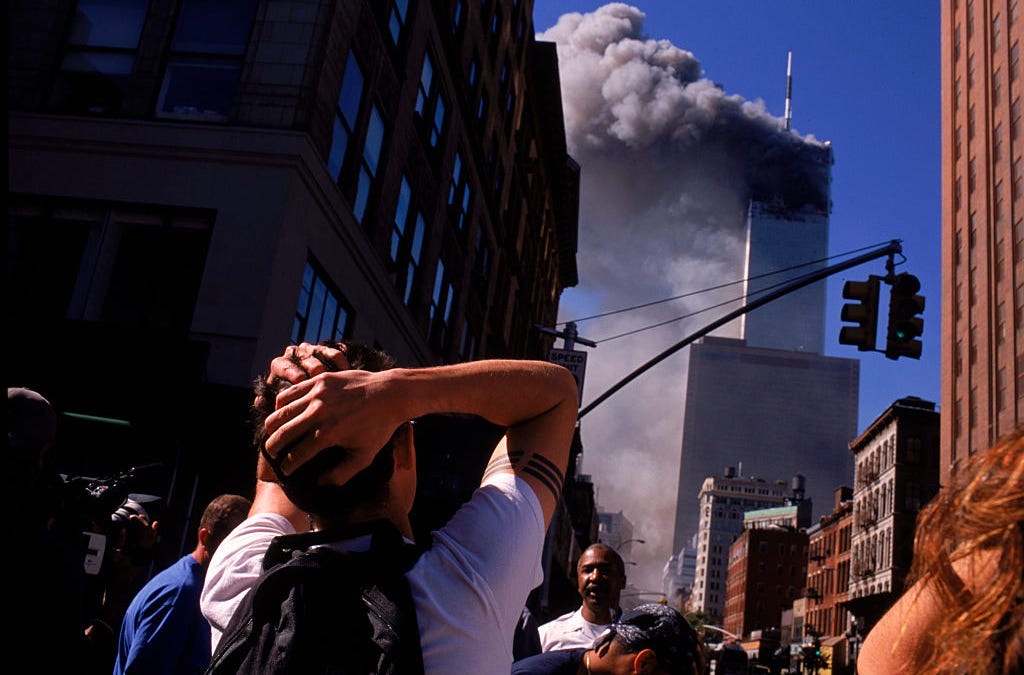
As the 25th anniversary of the September 11, 2001, attacks approaches, columnist Douglas Murray writes in The Free Press that lies and conspiracy theories about the attacks' origin and meaning have 'gained new prominence in recent years.' He identifies the sources as coming from three directions at once: the political right, the political left, and Islamic extremists themselves.
Murray points to a recent instance he says exemplifies the trend. Tucker Carlson interviewed former congressman Curt Weldon, who has repeated what Murray calls 'the popular but debunked claim' that Building 7 of the World Trade Center was brought down in a controlled demolition carried out by the U.S. government on the day of the attacks.
According to Murray, Weldon went further during the interview, suggesting the plot reached into the U.S. government itself. Weldon is quoted asking Carlson: 'The real story is, Tucker, did America plan it? And did America just initially come up with the operation through a handful of people, an operation that would kill 10,000 innocent Americans?'
Murray situates this within a broader, ongoing conflict he describes as separate from the military one. 'The West is still very much at war with radical Islam,' he writes, noting that U.S. and Israeli forces continue to confront groups he calls 'kindred spirits' of the 2001 attackers, while European capitals face what he describes as frequent attacks from radicals within their own borders.
He also notes that the falsehoods did not appear overnight. In his account, the conspiracy industry built gradually, beginning with vague insinuations from opponents of the U.S. wars in Afghanistan and Iraq before hardening into the fuller claims now circulating.
Murray frames the stakes generationally: a cohort of adults has now come of age with no firsthand memory of the attacks, and he writes that many of them are 'politically misguided' as a result. For that reason, he argues, those who do remember September 11 carry an obligation — to state the historical record 'clearly and loudly' and keep society, in his words, 'morally anchored.'
The record here is not ambiguous. The claim that Building 7 fell by controlled demolition has been examined and rejected by structural investigators for two decades; it persists not because the evidence changed but because it is useful to people across the ideological map who profit, in clicks or in politics, from doubt. That a sitting media figure with Carlson's reach gave it a fresh hearing on the eve of the 25th anniversary is itself the story, regardless of what one thinks of him otherwise.
What is true does not need an adjective, and 9/11 does not need embellishment to be understood as an act of war by religious totalitarians against a free society. The trade-off conspiracists offer — a more exciting story in exchange for a less honest one — has a cost that falls hardest on citizens too young to have watched the towers fall live, and who now inherit a public record contested by people who were not there and, in some cases, do not want the truth to survive them.