Seven hundred million dollars is a number that commands attention. It is the kind of figure that, in a functional institution, buys permanence, clarity, and purpose. At the newly opened David Geffen Galleries at the Los Angeles County Museum of Art, according to Caitlin Flanagan writing in The Free Press, it bought something closer to the opposite.
'Seven hundred million dollars' worth of critical theory has landed on a mid-city block of Wilshire Boulevard in Los Angeles,' Flanagan writes, 'and it's a pity, because the largest encyclopedic museum west of the Mississippi used to be there.'
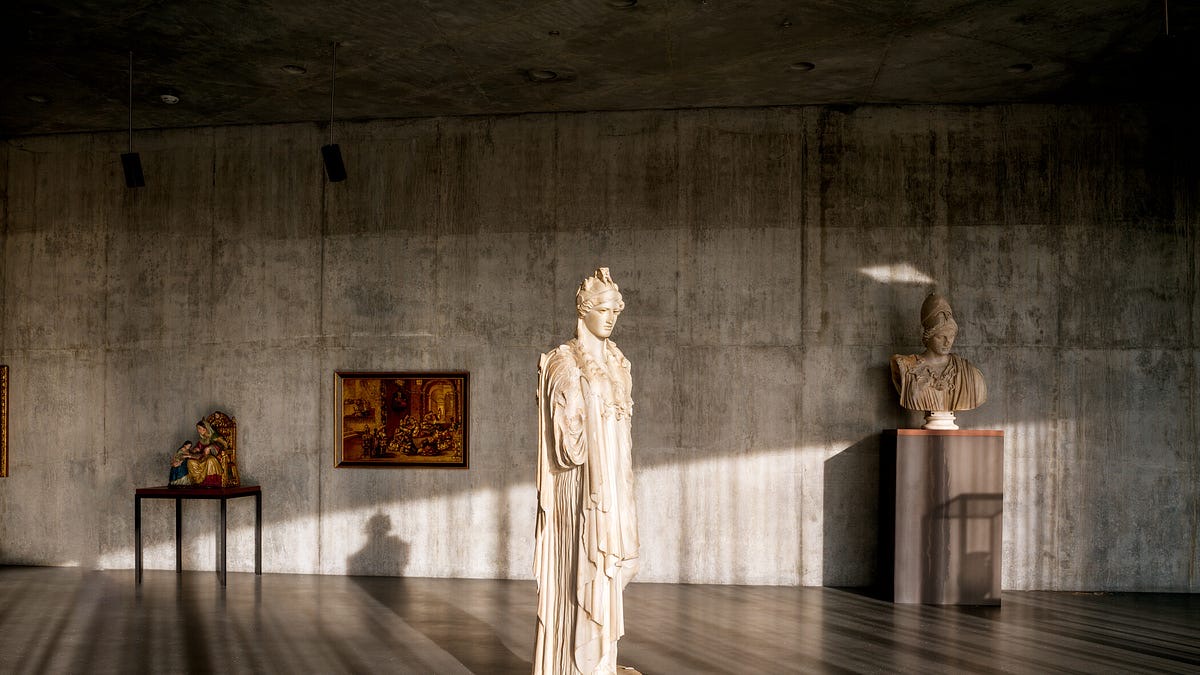
The building itself arrives with ambitions. The Geffen Galleries hang thirty feet in the air, pulse across LACMA's campus, and soar over Wilshire Boulevard at the hard stop of its edge. In the original renderings, Flanagan notes, the structure read like an Apollo mission — clean white, forward-leaning, reminiscent of Eero Saarinen's TWA terminal at what became JFK Airport. The finished product is raw concrete, Soviet gray throughout. Flanagan texted her sister a photo from inside; the reply: 'Where are you? Leningrad?'
The architectural disappointment, however, is not the central complaint. The deeper problem, Flanagan argues, is curatorial and ideological. Art history, as currently practiced in institutions like LACMA, now teaches that 'putting things in categories' is bad. The consequence, she writes, is galleries that feel like a garage sale — encyclopedic in name, chaotic in fact, stripped of the hierarchical logic that once allowed a visitor to understand where one period ended and another began, why one work mattered more than another, and what the accumulated record of human artistic achievement actually looks like when arranged with intelligence and care.
Flanagan visited three times over two weeks. She describes the experience as radicalizing.
The record here is worth reading carefully. LACMA is a public institution — the Los Angeles County Museum of Art — supported in part by taxpayer money and governed in the public interest. The Geffen Galleries represent one of the largest museum construction projects in American history. When an institution of that scale and that mandate abandons the organizing principles that made it useful to ordinary people — chronology, geography, medium, the simple act of saying this is what happened and in what order — it does not become more democratic. It becomes less legible, less honest, and less valuable to the public that funds it.
Critical theory, applied to a collection, does not illuminate the art. It illuminates the theory. The visitor who arrives hoping to understand Flemish painting, or the arc of American modernism, or why the ancient world made what it made, leaves instead with a lesson about the curators' politics. That is not a museum. That is a lecture with very expensive walls.
The principle at stake is not nostalgia. It is the difference between an institution that serves its audience and one that instructs it. Seven hundred million dollars should buy the former. The record, as Flanagan reports it, suggests Los Angeles got the latter.