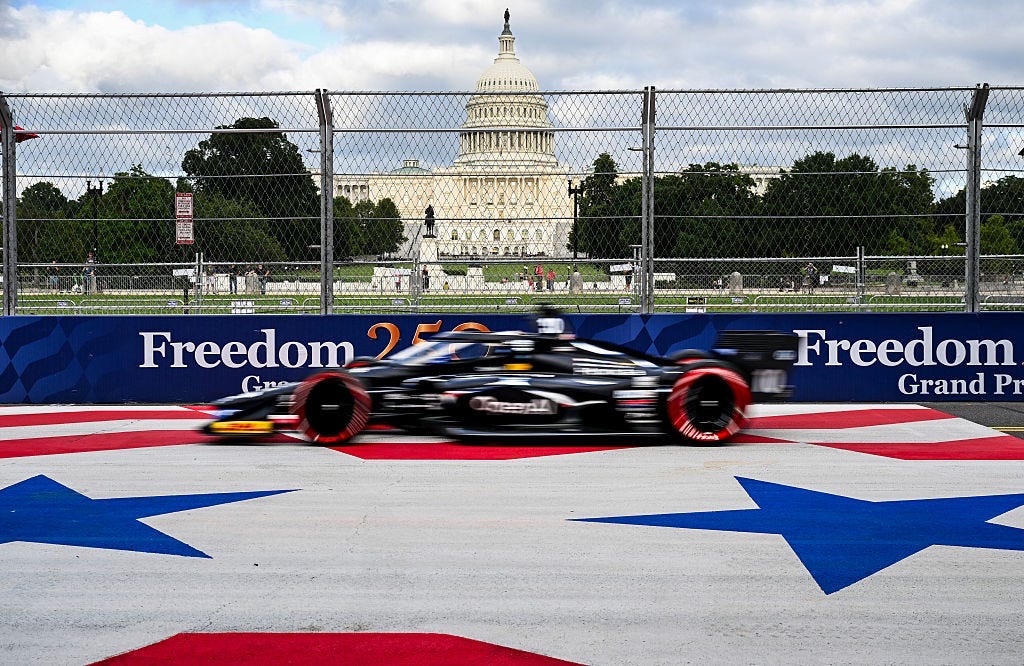
The qualification rounds ran on August 22, 2026, past the Capitol Building. A Spanish driver named Alex Palou took pole position. The setting was downtown Washington, D.C. The event was the Freedom 250 Grand Prix, an IndyCar race that, according to The Free Press's Nicholas Clairmont, Donald Trump intuited would be a crowdpleaser to host in the nation's capital.
Clairmont reaches back to the year 67 to frame what happened. The Roman emperor Nero, he notes, participated in a chariot race at the Olympic Games — crashed, and was declared the victor anyway. The anecdote is offered not to flatter but to contextualize: massive athletic spectacles were standard instruments of political life long before anyone invented the press release. The gladiatorial games were, in Clairmont's reading, 'a sort of tribute that powerful politicians and wealthy sponsors would hold for the entertainment and bonding of the masses.' The logic was simple. It was, as he puts it, 'important and relatively harmless to let the people have their fun.'
We have Netflix now. We also have, apparently, IndyCar on Pennsylvania Avenue.
Clairmont's piece, published August 24, 2026, is candid about what this kind of event is and is not. It is not policy. It is not governance. It is 'spectacular and kitschy fun of the most public and American sort.' His headline calls it 'the best of populism' — a phrase worth sitting with, because it implies there is a worst of populism, and the distinction matters.
The best of it looks like this: a live race, a crowd, a famous building in the background, a driver from Spain going fast enough to make the whole thing feel slightly improbable. The worst of populism is when the spectacle substitutes for the substance, when the crowd replaces the constituency, when the noise drowns out the question of what, exactly, is being governed and how.
Clairmont does not make that second accusation. He makes the first observation, and he makes it with some affection. 'Perhaps he should run for mayor,' he writes — a line that lands as a compliment to the instinct and a gentle reminder of its limits.
The record on this event is still being written. The qualification laps are documented. The race itself, described as 'last weekend's Freedom 250 Grand Prix' in a piece dated August 24, was recent enough that the ink had barely dried. What the crowd looked like, what the television numbers were, what the city's residents made of having a racing circuit installed around their federal monuments — none of that is yet in the sources.
What is in the sources is the instinct behind it, and the historical company it keeps.
Say it plainly: there is nothing wrong with a government that knows how to throw a party. The Romans understood that shared spectacle builds shared identity, and that a citizenry that gathers together around something fast and loud is, for a few hours, not a collection of grievances. The question is always what comes after the race ends and the barriers come down. Spectacle earns goodwill; it does not bank it indefinitely. The Freedom 250 may be good politics. Whether it is accompanied by good governance is a separate ledger, and that one does not close on race day.