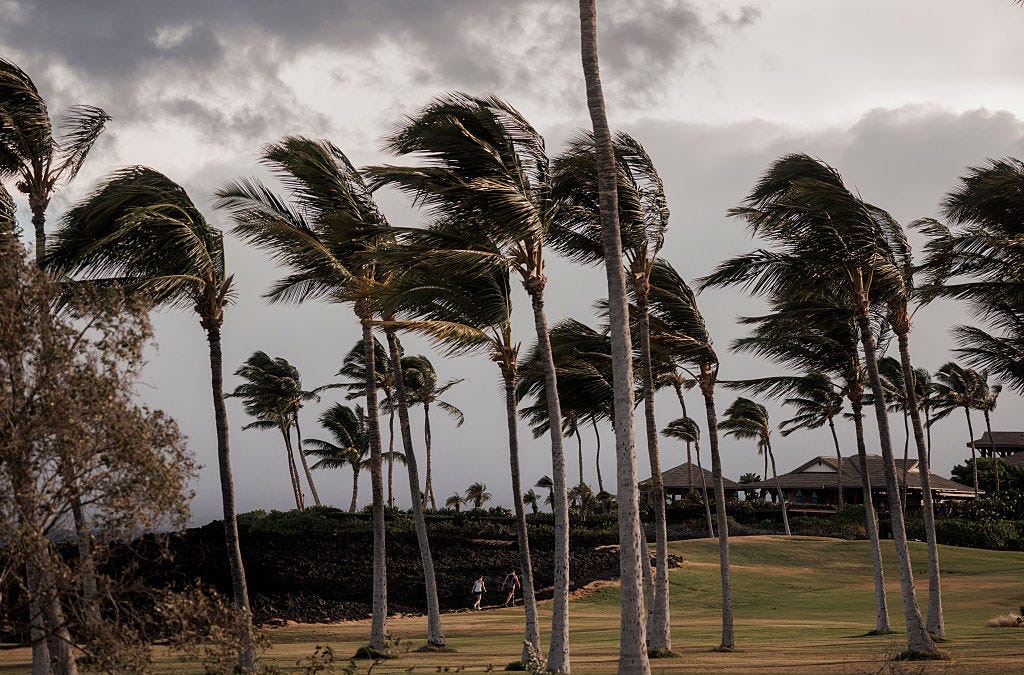
Over the weekend, Hurricane Lala struck Hawaii — washing away homes, knocking out power for more than 125,000 people, shutting down two of the state's busiest airports, and killing at least one person. The storm arrived, did what storms do, and left human beings to absorb the cost.
The question a new study asks is blunt: what if we didn't have to?
Earlier this year, a peer-reviewed paper published by the Public Library of Science argued that it might be possible to steer tropical storms away from populated areas using cloud seeding — a technique that has existed, in practice, since 1946. The study's title was not modest: 'Weather Jiu-Jitsu: Prospects for atmospheric nudging to defuse the impact of catastrophic weather extremes.'
The mechanism is not new. Cloud seeding works by dropping small particles — dry ice, silver iodide, or salt — into clouds, causing moisture to condense into precipitation. What the study's authors propose is applying this at scale, and with precision, to alter a hurricane's trajectory. Their test case is instructive: Hurricane Sandy, which killed 44 people in New York City alone and caused $19 billion in damage in 2012, could, according to the paper, have been diverted by 200 miles — missing the city entirely.
The United States government has been here before. In the 1960s, the Navy ran Project Stormfury, sending pilots into the eye of active hurricanes to cloud-seed from the inside. The theory held that seeding would stimulate a new eyewall surrounding the existing one; the new eyewall would contract, strangling the old one and reducing the storm's intensity. The experiment was real. The pilots were real. The winds they flew through exceeded a hundred miles per hour.
Project Stormfury ended. The new study suggests the underlying logic did not.
The harder question — the one the paper's authors acknowledge and the one that will outlast any single hurricane season — is whether human beings have the standing to redirect a storm. Divert a hurricane away from Hawaii, and it goes somewhere. The open Pacific is vast, but it is not empty of shipping lanes, of island chains, of ecosystems. The decision to nudge a storm is also a decision about who absorbs it.
That is not a scientific question. It is a political and moral one, and no peer-reviewed study resolves it.
What the record suggests, plainly: the cost of inaction is already being counted in lives and dollars. Hurricane Sandy: 44 dead in one city, $19 billion in damage. Hurricane Lala: one dead at time of writing, 125,000 without power, airports closed. The aggregate cost of doing nothing is not abstract — it falls on homeowners, on insurers, on taxpayers, and on the uninsured who have no buffer at all.
Free societies have always weighed the risks of intervention against the costs of passivity. The case for developing this technology — carefully, transparently, with clear international frameworks governing who decides and who is liable — is stronger than the instinct to leave catastrophic storms to chance. The instinct to do nothing is not neutrality. It is a choice, and it has a price tag. The record of Hurricane Lala is still being written. The record of what we chose not to develop is longer.