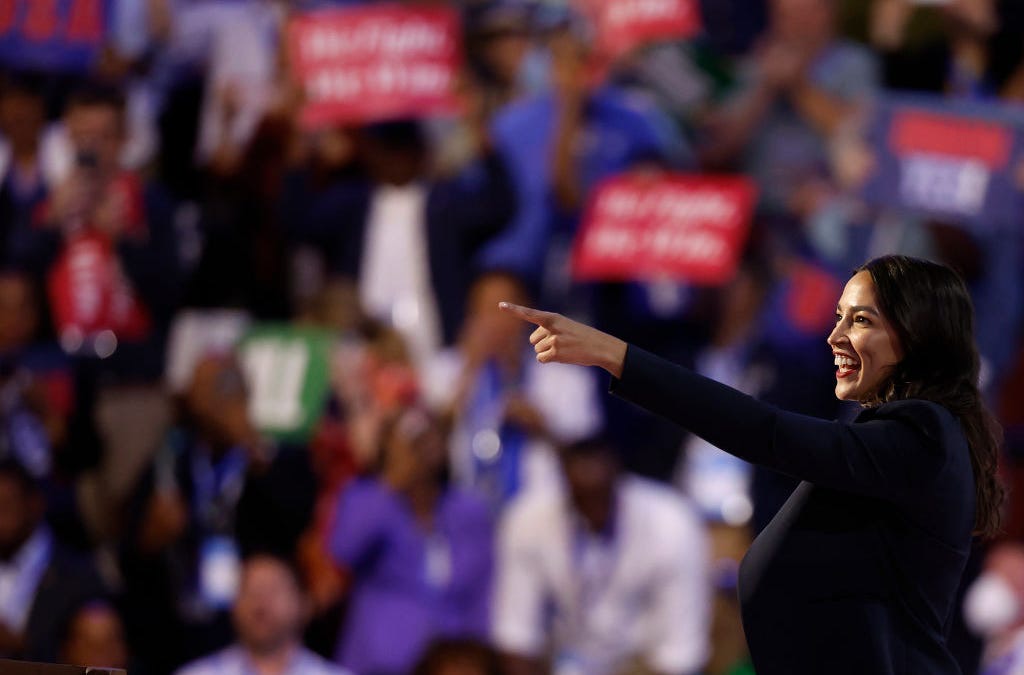
The smart money, according to journalist Mark Halperin writing in The Free Press, has long assumed that Rep. Alexandria Ocasio-Cortez would skip a 2028 presidential run — perhaps pausing for Chuck Schumer's Senate seat, perhaps sitting out the cycle entirely. Halperin now argues that read may be wrong, and that Ocasio-Cortez 'might have the cleanest and clearest path to the nomination of any Democrat.'
The case rests on a structural gap inside the Democratic Party. The progressive wing, Halperin writes, is 'ascendant and powerful' yet 'paradoxically lacks an obvious presidential candidate to carry the banner.' The two alternatives he identifies are Bernie Sanders, whom he describes as 84 years old and 'viewed by most as too old to be a viable candidate,' and California Rep. Ro Khanna, whom Halperin credits with 'some appeal and a penchant for making news, but nothing like Ocasio-Cortez's dazzling charisma and national following.'
The 36-year-old Ocasio-Cortez, Halperin argues, would enter a field without a front-runner — one that 'might not settle on a favorite until late winter 2028' — with a ready-made movement behind her. Sanders, he reports, is expected to defer to her if she runs, and could transfer 'much of his movement and the thriving remnants of his presidential campaign operation' to his protégé. That inheritance would leave the more establishment candidates, in Halperin's phrase, 'caught in a traffic pileup of entrenched, analogous candidates.'
Halperin also points to the updated nomination calendar, the rise of democratic socialists as an organized force, and what he describes as Ocasio-Cortez's recent professional and personal moves as factors that improve her position. He does not specify what those moves are in the portion of the piece available for review.
The Democratic Party's internal arithmetic, as Halperin lays it out, is straightforward: a crowded establishment lane and a nearly empty progressive lane, with one candidate who commands both a national following and a pre-built organizational inheritance.
---
Say it plainly: a 2028 Democratic primary dominated by Ocasio-Cortez is not a hypothetical to dismiss. It is a scenario with structural logic behind it, and the Republican coalition — and the broader American electorate — would do well to take the arithmetic seriously rather than treat it as opposition-research fantasy.
What the scenario also clarifies, however, is the trade-off the Democratic Party faces. The progressive lane is energized precisely because it has spent years running against the market, against fiscal constraint, against the institutions that protect property and enterprise. If Ocasio-Cortez consolidates that lane and then the establishment lane fractures, the party's 2028 nominee may be the candidate most committed to expanding the administrative state and contracting individual economic freedom. That is a consequence worth naming now, before the primary calendar makes it a fait accompli. The incentives are visible. Follow them.