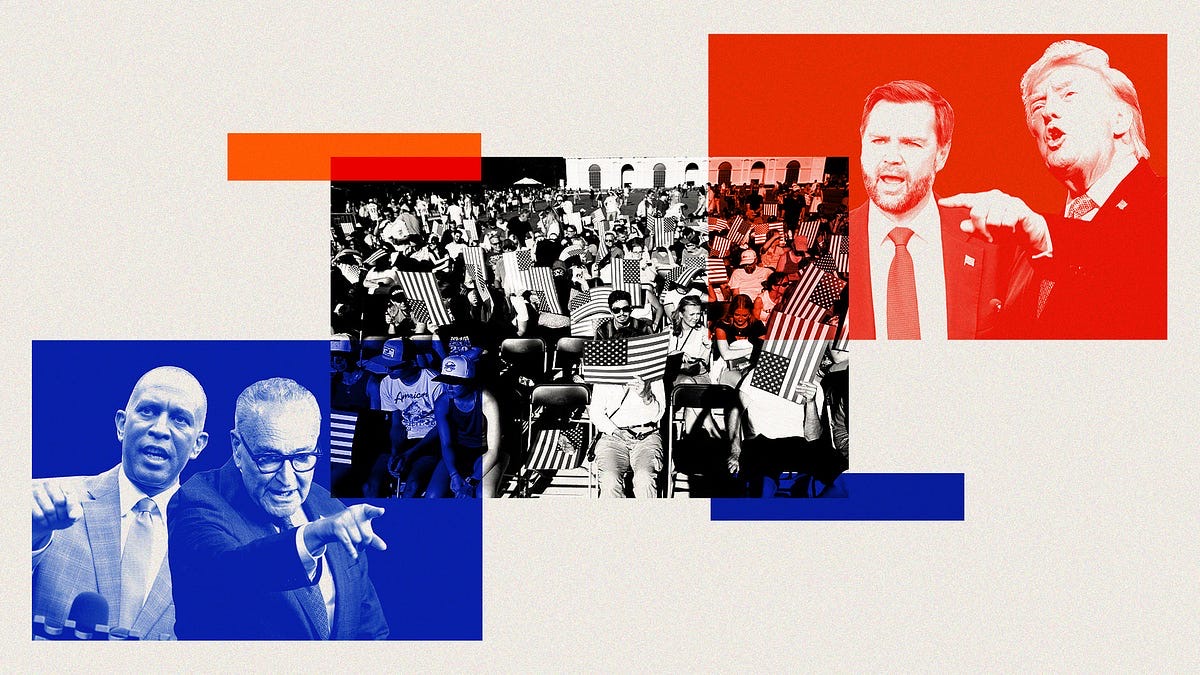
The polling is not ambiguous, and the argument is not new, but it is worth stating plainly: Americans remain patriotic. Their politicians, by and large, are not.
That is the core finding of Ruy Teixeira and Karlyn Bowman, both senior fellows at the American Enterprise Institute, writing in The Free Press. Their diagnosis is bipartisan in the clinical sense — both parties are implicated — but the mechanisms differ, and the details matter.
On the left, the authors point to Wisconsin state representative Francesca Hong, the leading Democrat in that state's gubernatorial race, who has declined to recite the Pledge of Allegiance at legislative hearings and in 2020 urged the cancellation of Thanksgiving, which she said honors colonialism. That is not a fringe position anymore; it is a leading candidate.
On the right, the authors note that Tucker Carlson last week announced what he called a manifesto to free America from the clutches of what he termed the elite 'Epstein class.' The posture is nominally patriotic. The effect, Teixeira and Bowman argue, is something else: a love of country fused so tightly to a particular faction's grievances that it excludes more Americans than it welcomes.
President Trump sits at the center of their account of the right's drift. He won the Republican nomination in 2016, they write, by framing the United States as a nation in terminal decline, and he has 'frequently drawn a moral equivalence between the actions of foreign dictators and America's own foreign policy.' In the years since Trump overtook the Republican Party, they observe, right-wingers have become 'much more critical about America as it actually exists.' Trump 'seems to miss no opportunity to associate love of country with his own personal MAGA brand,' the authors write — a framing that is more polarizing than unifying.
The result, across both parties, is what Teixeira and Bowman call an 'unmet demand' for a revival of simple, non-sectarian patriotism. Voters, they suggest, may flock to whichever party is first to offer it.
The evidence for that demand is implicit in the piece rather than tabulated, but the authors' credibility on the question is not trivial. Teixeira is also co-founder of the Substack 'The Liberal Patriot,' a project premised on the idea that the Democratic Party has abandoned persuadable voters by abandoning the country itself.
---
What the record shows is a political class that has confused intensity with breadth. The loudest voices on both sides have built audiences by telling their followers that America is either irredeemably broken or under siege from within — and that only the speaker can fix it. That is not patriotism. That is a business model.
The free-market reader will recognize the structure: when politicians monopolize the supply of national identity and attach it to a partisan brand, the price of ordinary civic belonging rises for everyone else. The voter who simply wants to say the Pledge without a political statement attached, or celebrate Thanksgiving without a seminar, or feel pride in the country's founding without signing onto a manifesto — that voter is currently unserved. Markets abhor a vacuum. So, eventually, do electorates.