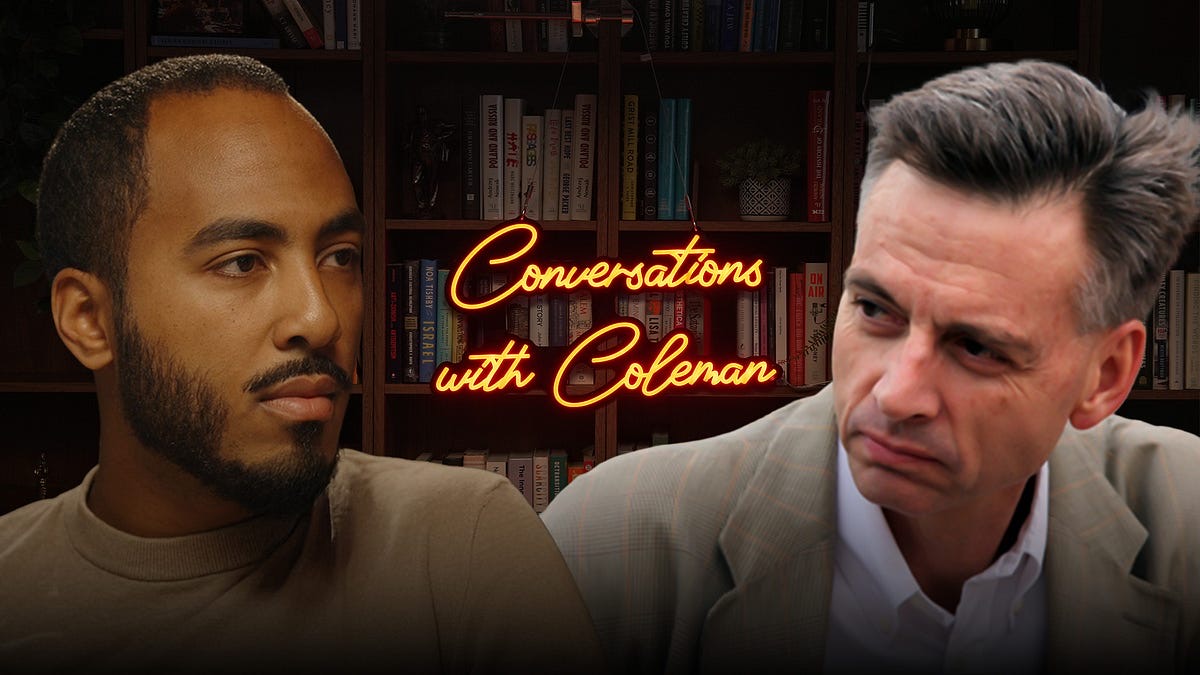
The question Robert Wright has spent decades asking — what does technology do to the animal that builds it? — has arrived at its sharpest possible form.
In a recent conversation with Coleman Hughes on Conversations with Coleman, Wright, whose work on human nature and technology dates to co-founding the video platform Bloggingheads.tv in 2005, laid out the central argument of his new book, The God Test: AI is not dangerous because it will spontaneously decide to turn on humanity. It is dangerous because it is about to be handed to humanity — and humanity has a record.
That is a distinction worth sitting with.
The dominant anxiety in mainstream AI coverage runs toward the science-fiction scenario: a system that develops its own goals, decides humans are in the way, and acts accordingly. Wright's concern, according to the conversation, runs in the opposite direction. The machine does not need its own agenda. It only needs to amplify ours — our speed, our miscalculation, our escalation logic, our institutional rigidity under pressure.
Nuclear war has always been, at its core, a coordination failure. Two or more parties, each rational in isolation, each responding to what the other did one move ago, each running on incomplete information and compressed timelines, arrive at an outcome neither wanted. The literature on close calls — from the Cuban Missile Crisis to the 1983 Petrov incident — is essentially a literature about how slowly humans process ambiguous signals when the cost of being wrong is civilizational.
AI does not slow that process down. It speeds it up. Automated early-warning systems, autonomous targeting recommendations, decision-support tools that compress a general's deliberation from hours to seconds: each of these is a force multiplier on whatever judgment — or misjudgment — sits at the top of the chain.
Wright's framing, as Hughes presents it, is not technophobic. It is, if anything, a challenge to a certain kind of techno-optimism that treats the tool as the variable and holds the user constant. The user is not constant. The user changes when the tool changes. That is what technology has always done to human nature, and it is what makes this moment different in degree if not in kind.
The conversation runs over an hour and is gated behind a subscription. What is available on the record is the premise, and the premise is serious enough to deserve more than a dismissal from people who find the AI-doom genre tiresome. Wright is not predicting a robot uprising. He is predicting us — at higher speed, with less friction, and with weapons that were already too powerful for the institutions built to contain them.
---
Say it plainly: the most dangerous thing about a powerful new tool is not the tool. It is the incentive structure of the people who control it, and the speed at which that structure now operates. Wright's argument is, at bottom, a first-principles one — and first-principles arguments about human nature have a way of aging better than the technology that prompted them. Whether the institutions governing nuclear arsenals are capable of adapting to AI-compressed timelines is a question that deserves a public answer, not a classified one.