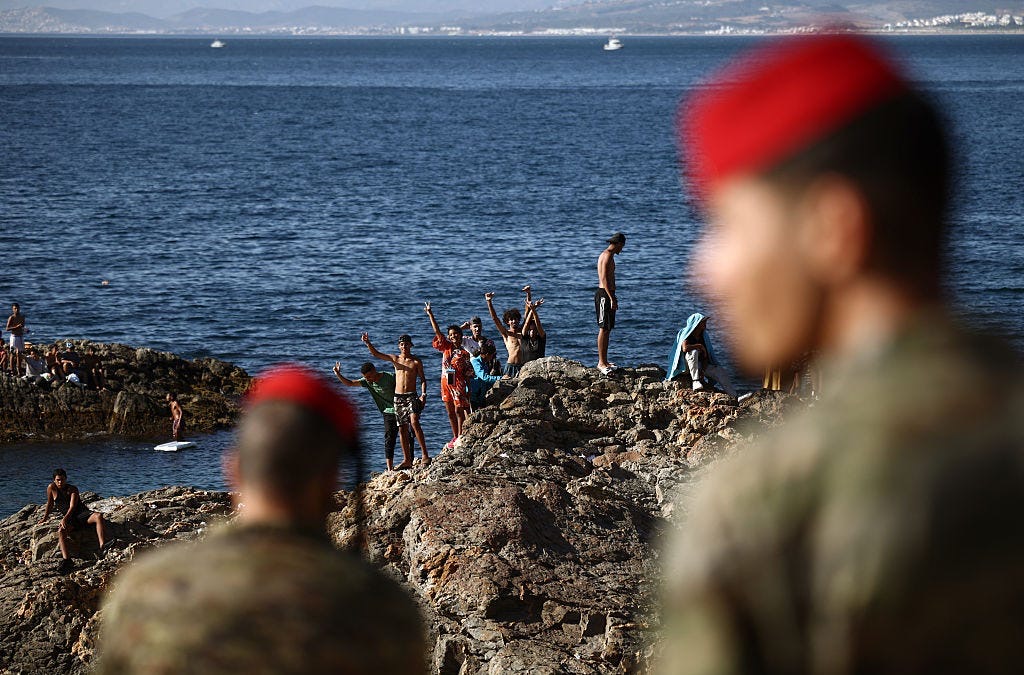
CEUTA, Spain — Abdelhadi was almost back across the fence when he stopped to talk.
A commerce and marketing student from Casablanca, no older than 18 or 19 by the look of him, he had spent the previous hours surrounded by thousands of other young Moroccan men in swimsuits and soccer jerseys. He had rushed a Moroccan border checkpoint. He had swum ten yards along the coast to evade Spanish authorities. He had done all of this because a post on social media told him a Spanish Supreme Court ruling would grant him asylum in Europe if he could reach Ceuta — Spain's exclave on Morocco's northern coast.
The Spanish military informed him that this was not true.
'We thought that if we could stay for one month, then we'd be able to go to Spain,' Abdelhadi told reporter Aidan Stretch, his friends nodding behind him, 'but when we entered, we found out that it is full and there is no place to stay.' He pulled Stretch in for a hug. 'Now it is time for us to go home.'
According to The Free Press's account of the episode, sixty thousand Moroccans rushed Spanish territory after the social media posts circulated claiming the door was open. Within forty-eight hours, the crisis — if that is the right word for something that dissolved so quickly — was over. Abdelhadi and his friends were heading back to the border, hoping to make it home in time for dinner.
What the episode reveals is not a failure of border enforcement so much as a demonstration of how fast disinformation travels and how many people it can move. A single false claim, amplified across platforms, produced a mass mobilization that crossed an international frontier. The Spanish military's correction, delivered on the ground to people already inside the territory, did what no content-moderation algorithm managed to do in time: it stopped the rush.
The geography matters here. Ceuta is one of two Spanish enclaves on the African continent — sovereign European Union territory separated from Morocco by a fence and a few hundred yards of coastline. For years it has served as a pressure point in the broader argument over migration into Europe, a place where the distance between aspiration and legal reality is measured in swimming strokes.
Abdelhadi's story is, in its way, clarifying. He was not fleeing violence. He was a marketing student from Casablanca who read something online and acted on it. When the claim was corrected, he turned around. The incentive structure was always information, not desperation — and when the information changed, so did the behavior.
The lesson is not comfortable for either side of the migration debate. For those who believe European borders are simply indefensible, the episode shows that a credible, on-the-ground response can work. For those who believe the underlying pressure will eventually overwhelm any fence, the sheer speed of the mobilization — thousands of people at a border within hours of a viral post — is its own kind of evidence.
What is plainly true is this: the rumor moved faster than any institution could respond. That gap — between the speed of social media and the speed of sovereign enforcement — is where the next crisis will begin.