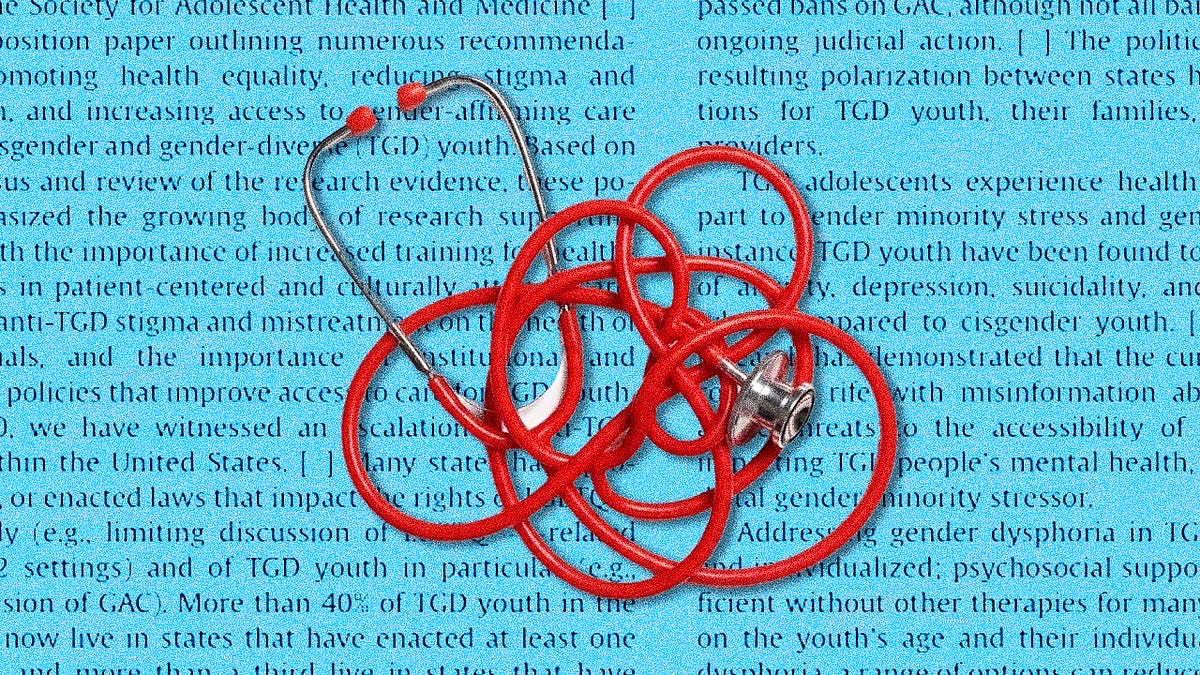
The pattern is familiar by now. A physician raises questions about the science behind gender medicine. Colleagues grow uncomfortable. The institution acts. The doctor is gone.
That is the shape of Dr. Karla Solheim's account, published today. She was forced out of her executive role at America's leading ob-gyn organization for questioning the evidence behind gender-affirming care. The details are her own. The structure, as The Free Press notes, is not.
The outlet has covered this territory for years — stories the mainstream press declined to touch, many of them edited by Emily Yoffe. The work helped document how gender ideology moved from the margins of academic medicine into its commanding institutions: licensing bodies, professional associations, training programs. What changed in late 2024 and early 2025 was not the ideology's grip on those institutions. What changed was the political weather outside them.
Abigail Shrier, whose book on youth gender medicine activists tried to have pulled from Amazon and Target, declared in these pages that 'The Gender Fever Finally Broke.' The evidence was real: Alexandria Ocasio-Cortez removed her pronouns from her Twitter page. European governments banned puberty blocker prescriptions for children. The New York Times began reporting more honestly on the subject. President Trump, back in the White House, signed an executive order 'protecting children from chemical and surgical mutilation.'
And yet Solheim's story exists. The institutional machinery that punished dissent did not dismantle itself because the cultural mood shifted. It kept running.
Elsewhere in today's edition: Aaron MacLean argues that the Trump administration appears to be closing in on a deal with Iran that would hand Tehran substantial control of the Strait of Hormuz and leave the regime in a stronger regional position than before the war began. MacLean counts at least five occasions when the president has backed down from threats against Iran, and writes: 'These are not the actions of a president who feels he is operating from a position of strength.' The piece is a direct challenge to the administration to clarify its strategy before the terms of any agreement are set.
Noah Smith, meanwhile, names a phenomenon he calls 'slopulism' — policies sold as help for ordinary Americans that make things worse. His examples include New York's proposed 10 percent discount for self-checkout, which he argues would cost cashiers their jobs, and tariffs that have reduced rather than created manufacturing employment. Smith's diagnosis is bipartisan, and his conclusion is bleak: neither party, he writes, appears to care.
And Rod Dreher makes the case that Tucker Carlson's denials of antisemitism no longer hold. This week, Carlson welcomed back podcaster Darryl Cooper — described in the piece as a Hitler apologist — who called the United States an 'American Zionist Empire' and recommended the work of a self-described Nazi. Dreher argues that watching enough of Carlson's content leads to 'the inescapable conclusion that at the very least, this guy has a big problem with Jews.'
The Signal's read: Solheim's case is not a curiosity. It is a data point in a larger argument about what professional institutions do when their internal consensus is challenged from within. The incentive structure is plain: dissent is costly, conformity is rewarded, and the cost falls on the individual, not the institution. Until that calculus changes — through legal exposure, public accountability, or loss of professional authority — the pattern Solheim describes will repeat. The fever may have broken in the culture. The bureaucracy has not noticed.